Every self-managed HOA has a set of CC&Rs, and almost nobody has read them. The document is typically 30 to 50 pages of dense legal language, formatted as a wall of text with numbered sections and cross-references to other sections that are equally impenetrable. Residents don’t read it when they buy their home. Board members skim it when they first join and rarely go back. The document that governs nearly every decision your community makes sits in a drawer — or, more likely, on a former board member’s laptop — functionally invisible to the people it applies to.
This is the problem I kept running into on my own HOA board, and it’s the reason I built EasyAsk.
The real cost of unread documents
When residents don’t know what the CC&Rs say, they email the board. Every question about fence heights, exterior paint colors, parking rules, or architectural changes becomes a message that a volunteer board member has to answer — often by opening the same PDF the resident could have read themselves, searching for the relevant section, and paraphrasing it in a reply.
This creates two problems at once. The board spends time answering questions that are already documented, and the resident waits days for an answer they could have found in seconds if the document were accessible. According to the Community Associations Institute, there are roughly 365,000 community associations in the United States, and the vast majority of board members across these communities are volunteers. Time spent manually fielding document questions is time not spent on the things that actually require a board’s judgment and decision-making.
In my experience on the board, the same handful of questions came up repeatedly. Can I put up a shed? What are the rules about renting my unit? Do I need approval to replace my front door? These aren’t complicated questions, and the answers are in the CC&Rs every time. The problem was never that the information didn’t exist. The problem was that nobody could find it without reading a document that no reasonable person would sit down and read voluntarily.
Why PDFs are the wrong format for community rules
Most governing documents exist as PDFs — often scanned from paper originals. A study by the Nielsen Norman Group found that PDFs are significantly harder for users to navigate and read than web-based content, particularly on mobile devices. For HOA documents, this problem is compounded by several factors:
1. Legal language is not written for residents. CC&Rs are drafted by attorneys for legal precision, not for readability. A homeowner who wants to know if they can build a pergola shouldn’t need to parse language written for a courtroom.
2. Cross-references are circular. Section 4.2 refers to Section 7.1, which modifies the definition in Section 2.3. Finding the answer to a single question can require jumping between multiple sections, and there’s no guarantee you’ll find all the relevant pieces.
3. Search is primitive or absent. If the PDF is a scanned image — which is common for older communities — you can’t even use Ctrl+F. The document is functionally unsearchable. Even when the PDF is text-based, keyword search only works if you already know the exact terminology the document uses, which most residents don’t.
4. Nobody returns to a 40-page document. Even a motivated resident who reads the CC&Rs once when they move in won’t remember the specifics six months later. When a question comes up, they’re more likely to email the board than to re-read the document.
The result is that governing documents become reference material that nobody references. They exist to be cited in disputes, not to be used as a daily resource by the people they govern.
What I built to fix it
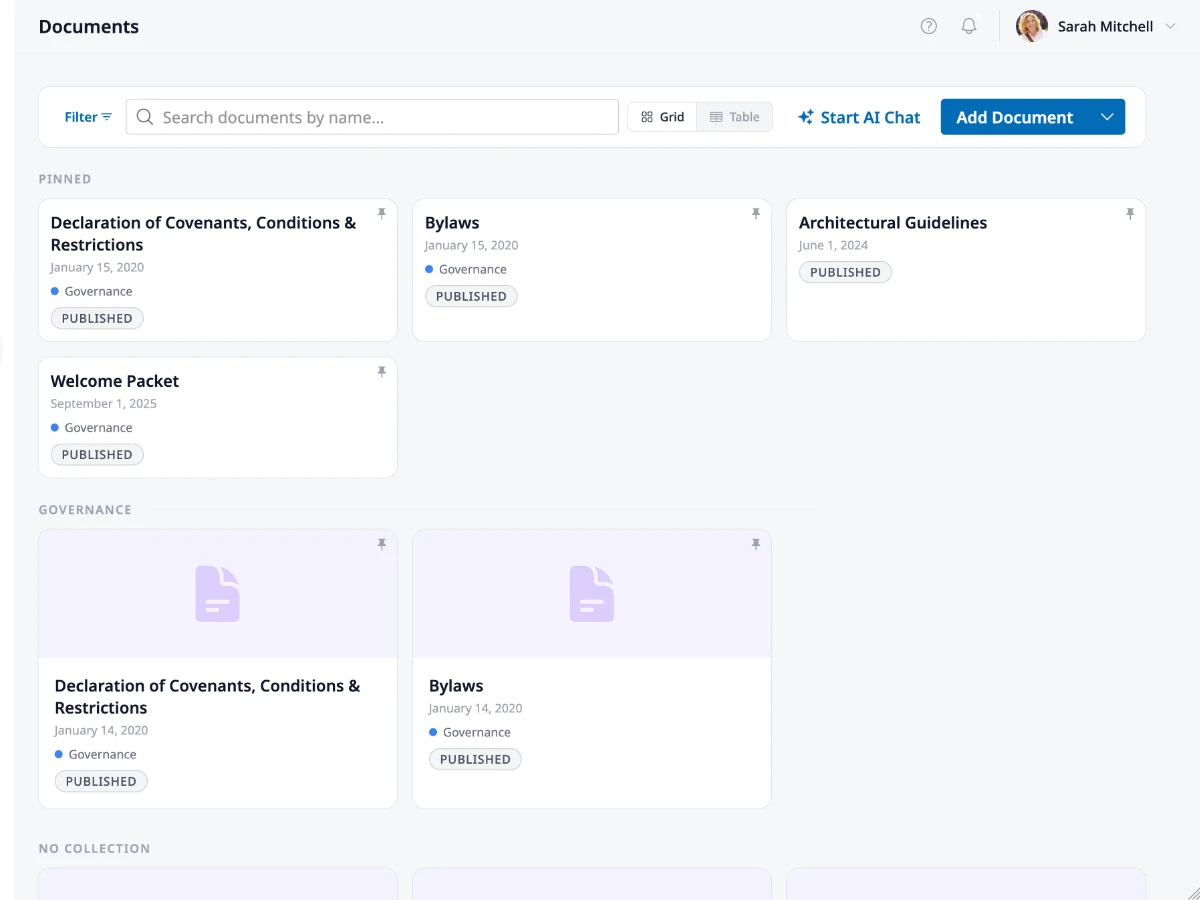
EasyAsk is the AI-powered document search I built into HOA Hub. The concept is straightforward: upload your community’s governing documents — CC&Rs, bylaws, meeting minutes, architectural guidelines — and let anyone in your community ask questions about them in plain English.
Here’s how it works in practice:
1. Upload your documents. You upload your CC&Rs, bylaws, and any other governing documents to HOA Hub. If they’re scanned PDFs, the system automatically converts them to searchable text using OCR. Even decades-old documents that were photocopied from paper originals become queryable.
2. Residents ask questions in plain language. Instead of opening a PDF and searching for keywords, a resident types a question the way they’d ask a neighbor: “Can I install a fence in my backyard?” or “What are the rules about parking an RV in my driveway?”
3. EasyAsk returns an answer from your documents. The AI reads across your community’s uploaded documents, finds the relevant sections, and provides an answer grounded in your actual rules — not generic HOA advice from the internet. The resident gets the information they need without waiting for a board member to respond.
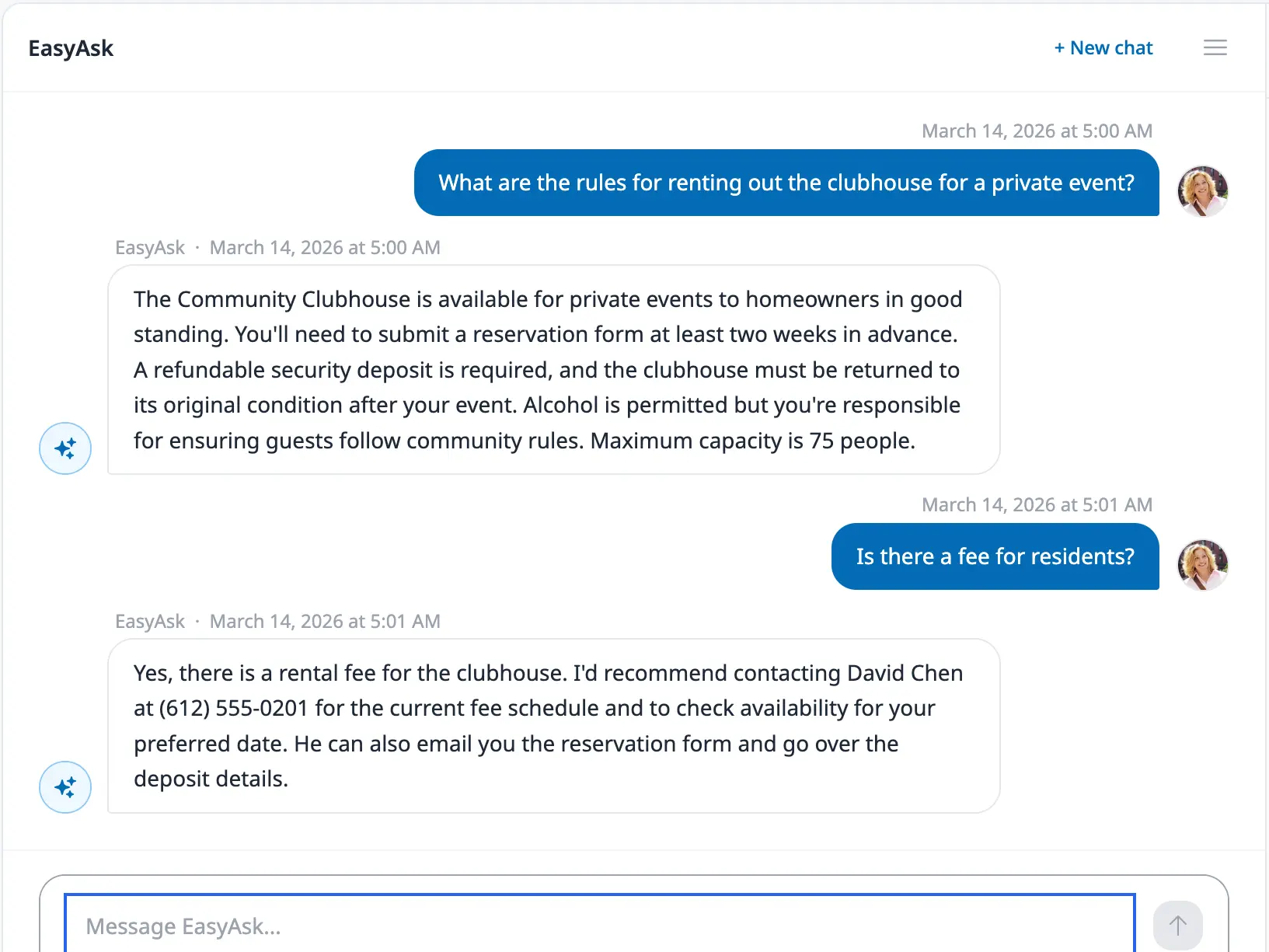
4. Board members use it too. During meetings or when responding to resident inquiries, board members can query the documents just as easily. Instead of flipping through pages to find the section on architectural modifications, you ask the question and get the answer with the relevant source.
Why this isn’t a gimmick
I understand the skepticism around AI in niche software. When every product adds “AI-powered” to its marketing, it’s fair to ask whether the technology actually solves a real problem or is just there for the label. With EasyAsk, the problem is concrete and measurable: residents don’t read governing documents, which creates a repetitive burden on volunteer board members who have to answer questions the documents already address.
AI document search changes the fundamental dynamic between residents and their community’s rules. Instead of governing documents being something the board interprets on behalf of residents, they become a resource residents can access directly. This shift has three practical effects:
1. Fewer repetitive emails to the board. When residents can find answers themselves, they stop emailing the board for information that’s already documented. This frees up volunteer time for decisions that genuinely require board discussion.
2. Faster answers for residents. A resident gets an answer in seconds instead of waiting days for a board member to check the CC&Rs and reply. The experience of interacting with your community’s rules goes from frustrating to instant.
3. More informed residents. When the rules are accessible, residents are more likely to check before they act. Fewer unauthorized modifications, fewer accidental violations, fewer conversations that start with “I didn’t know that was a rule.”
Key takeaway: AI document search doesn’t replace the board’s authority or judgment. It handles the straightforward, document-answerable questions so the board can focus on the decisions that actually need human discussion.
The questions EasyAsk is built for
The questions that drive the most value from AI document search are the everyday, rules-based questions that come up constantly in any community: “Do I need board approval to replace my windows?” “What’s the guest parking policy?” “When are dues collected and how much are they?” “Can I rent my unit on Airbnb?” “What are the quiet hours?”
These questions have definitive answers in the governing documents. They don’t require board deliberation. They just require someone to find the right paragraph in the right document — which is exactly what AI does well and humans do reluctantly.
For board members, the questions tend to be more specific: “What does Section 5.3 say about exterior modifications?” “What was decided about the landscaping contract in the March meeting minutes?” “What’s the process for issuing a violation notice?” When your meeting minutes and policy documents are all uploaded, EasyAsk becomes a searchable institutional memory that survives board turnover, which I’ve written about before as one of the biggest risks self-managed HOAs face.
A different kind of HOA technology
Most HOA software treats technology as a way to make administration more efficient. That’s valuable, but it’s incomplete. The reason I built EasyAsk — and the reason it’s central to HOA Hub’s approach to HOA Relationship Management — is that it changes the relationship between residents and their community. Documents stop being barriers and start being resources. Residents stop feeling like they need permission to understand the rules they live under. The board stops being the bottleneck for information that’s already written down.
That’s the shift I wanted to create when I started building HOA Hub. Not just better tools for the board, but a better experience for the entire community.
If your board is spending time answering questions that your CC&Rs already address, EasyAsk was built for exactly that situation. You can start your community for free and upload your documents to see how it works.

About the author
Jon Jakoblich
Founder of HOA Hub. HOA board member who got tired of managing a community through email chains and spreadsheets, so he built something better.
Ready to bring your community together?
Get started free on HOA Hub — no credit card required.
Create your hubKeep reading
HOA Hub vs. Email + Google Drive: What Changes When You Switch
A practical before-and-after breakdown of what changes when a self-managed HOA moves from scattered email and Google Drive to HOA Hub, workflow by workflow.
Read articleHow to Handle HOA Violations Fairly and Consistently
A practical guide for self-managed HOA boards on documenting violations, issuing notices, handling disputes, and building an enforcement record that holds up without a management company.
Read articlePlanning Community Events That People Actually Attend
Practical tips for planning HOA community events that residents actually show up to — from RSVP management and promotion to avoiding the common mistakes that turn a work day into chaos.
Read article